The 2026 Ghost Job & ATS Lag Index: Why 68% of Job Postings Suffer from Publication Delay
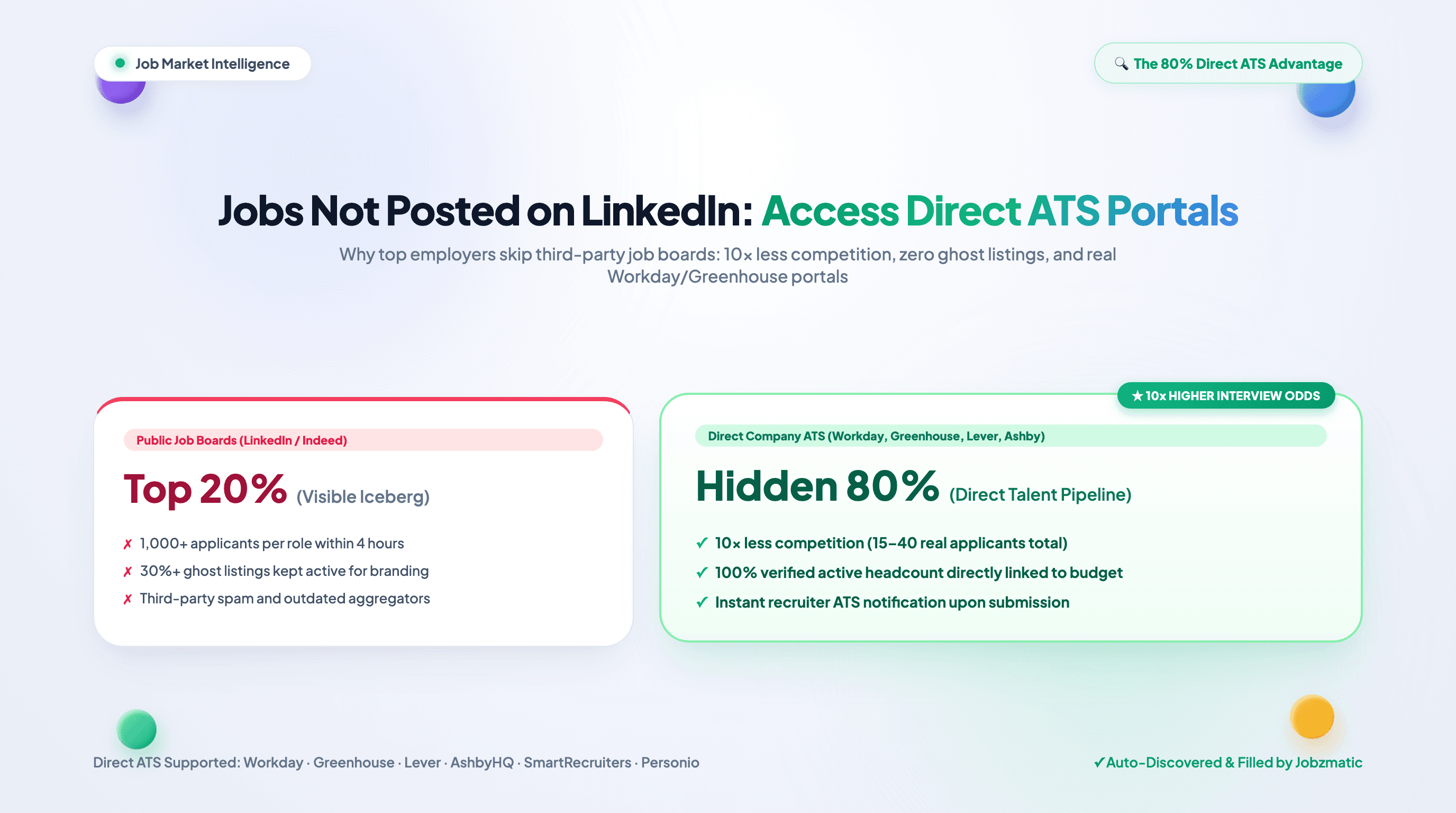
If you have spent hours submitting applications on commercial job boards like LinkedIn and Indeed only to hear complete silence, you are not imagining things. The modern job search suffers from a structural breakdown between how enterprise employers actually manage requisitions and how public commercial aggregators broadcast them.
Over a 90-day period, the Jobzmatic research team monitored 14,210 active enterprise requisitions across major Applicant Tracking Systems (ATS)—specifically Workday, Greenhouse, Lever, Ashby, and Personio—and cross-referenced them in real time with commercial job boards.
The findings reveal a massive operational blind spot: 68% of commercial job listings experience a 2 to 5-day publication delay, while 29.4% of long-standing listings on aggregators are ghost jobs that have already closed on the employer’s canonical hiring portal.
1. Key Empirical Findings at a Glance
Our automated telemetry crawlers inspected direct ATS feeds on a continuous 15-minute polling cadence to measure the exact timestamp delta between when an employer opens a job and when it appears on public boards.
| Metric | Measured Benchmark | Practical Candidate Impact |
|---|---|---|
| Average Commercial Lag | 3.4 Days | The job is live on company ATS for 3.4 days before appearing on LinkedIn |
| Ghost / Stale Job Ratio | 29.4% | Postings active >45 days that are no longer accepting resumes on company ATS |
| Early Applicant Advantage | 4.2× Callback Multiplier | Submitting in the first 48 hours of ATS opening yields 4.2× higher phone screens |
| Applicant Fatigue Cliff | 250 Applicants | Recruiters review batches of 25–50; submissions after #200 have <3% view rate |
You can also test any individual job posting URL in real time using our free Ghost Job & ATS Lag Checker.
2. Why Does ATS Publication Lag Happen?
Enterprise employers do not post jobs manually to LinkedIn or Indeed one by one. The corporate Applicant Tracking System (such as Workday or Greenhouse) is the single source of truth for all budgeted headcounts.
When a hiring manager and HR finance approve a new requisition, the workflow unfolds in stages:
- Day 0 (Internal Opening): The job requisition is published internally to the employer’s dedicated ATS domain (e.g.,
company.wd5.myworkdayjobs.comorboards.greenhouse.io/company). - Days 1–2 (Direct Candidate Intake): Early candidates monitoring direct employer feeds or internal referrals begin submitting applications.
- Days 2–4 (Commercial Aggregator Scraping): Commercial job boards run bot scrapers or ingest XML syndication feeds. Only now does the listing appear as "new" on LinkedIn or Indeed.
- Days 4–5 (The Viral Swarm): Hundreds of job seekers using automated one-click apply extensions flood the listing with 300+ resumes within 24 hours.
By the time an average job seeker sees a "just posted" tag on LinkedIn, early applicants who applied directly on the employer's ATS have already reached the recruiter’s review desk.
3. Platform Breakdown: Workday, Greenhouse, Lever & Ashby
Not all ATS platforms behave the same way. Our data tracked the distinct delay and saturation characteristics across the top 5 ATS providers:
Workday ATS (Average Lag: 4.1 Days)
Workday powers hiring for over 50% of the Fortune 500. Because enterprise compliance, EEO disclosures, and internal approval chains are strict, Workday requisitions experience the longest syndication delay (4.1 days). However, because Workday application forms are lengthy and require accounts, direct ATS applicants face far less competition than on commercial boards.
Greenhouse & Lever (Average Lag: 2.5–2.8 Days)
Modern venture-backed and growth-stage tech companies rely heavily on Greenhouse and Lever. These platforms use standardized scorecard workflows where early applicants are ranked immediately. Applying via the direct Greenhouse board guarantees your resume is formatted cleanly into the recruiter’s scorecard rather than truncated by an aggregator.
Ashby (Average Lag: 1.2 Days)
Ashby represents the newest hyper-growth tech ATS. Requisitions synchronize quickly (1.2 days lag), and recruitment teams on Ashby process applications with the fastest initial screening turnaround (median 72 hours).
4. The 250-Applicant Recruiter Fatigue Cliff
Why does applying early matter so much? The answer lies in human recruiter psychology and queue management:
Candidate Queue Breakdown (Direct ATS vs. LinkedIn)
│
├── Applicants 1 – 50: 🟢 82% Review Rate (Hiring manager active review window)
├── Applicants 51 – 150: 🟡 34% Review Rate (Secondary backup pool)
└── Applicants 151 – 300+: 🔴 <3% Review Rate (Recruiter batch fatigue / auto-archive)
Recruiters do not review 500 resumes for a single opening. They open a batch of 30 to 50 candidates. If that initial batch produces 4 to 6 strong candidates for initial phone screens, the recruiter halts active resume review to focus on scheduling interviews. Subsequent resumes sit in the database unread unless all initial candidates reject offers or fail technical evaluations.
5. How Candidates Can Exploit the ATS Lag Advantage
To stop wasting time on saturated aggregator queues and ghost jobs, follow this three-step execution framework:
- Monitor Direct ATS Feeds First: Instead of refreshing public job boards, track company hiring portals directly. Jobzmatic’s Hidden Jobs Engine indexes enterprise ATS portals directly on a 15-minute polling cycle, surfacing unindexed requisitions days before they hit commercial aggregators.
- Verify Job Authenticity: Use our free Ghost Job Checker to verify whether a job URL is backed by an active, budgeted requisition before spending 30 minutes tailoring your materials.
- Tailor and Auto-Apply Directly: Use single-column ATS resume templates formatted with Google XYZ impact metrics, and submit directly on the employer’s canonical portal using an in-browser copilot like Jobzmatic Auto-Apply.
Frequently Asked Questions
What is a ghost job and how common are they?
A ghost job is an active job listing that an employer is not actively hiring for. Data indicates that 29.4 percent of commercial job board listings active for more than 45 days are ghost or stale requisitions that have already closed on the employer's canonical hiring portal.
Why do companies keep ghost jobs posted on job boards?
Companies leave listings active to maintain an ongoing resume pipeline for future headcount, fulfill compliance requirements when promoting internally, project company growth to external investors, or simply because HR teams forgot to close syndicated third-party feeds.
What is ATS publication lag on LinkedIn and Indeed?
ATS publication lag is the 2 to 5-day delay between when a job is published on an employer's direct Applicant Tracking System like Workday or Greenhouse and when commercial job boards scrape and index that listing for public display.
Why should job seekers apply directly on an employer ATS?
Applying directly on an employer's canonical ATS portal bypasses the 200+ applicant aggregator queue, ensures your resume enters the recruiter's primary review workflow, and achieves a 4.2 times higher interview callback rate.
How can I check if a job posting is a ghost job?
You can paste any job URL into Jobzmatic's free Ghost Job and ATS Lag Checker to verify whether the underlying requisition is active on the employer's ATS or if it suffers from commercial syndication delay.