How to Write a Resume Summary: 15 ATS-Ready Examples for 2026
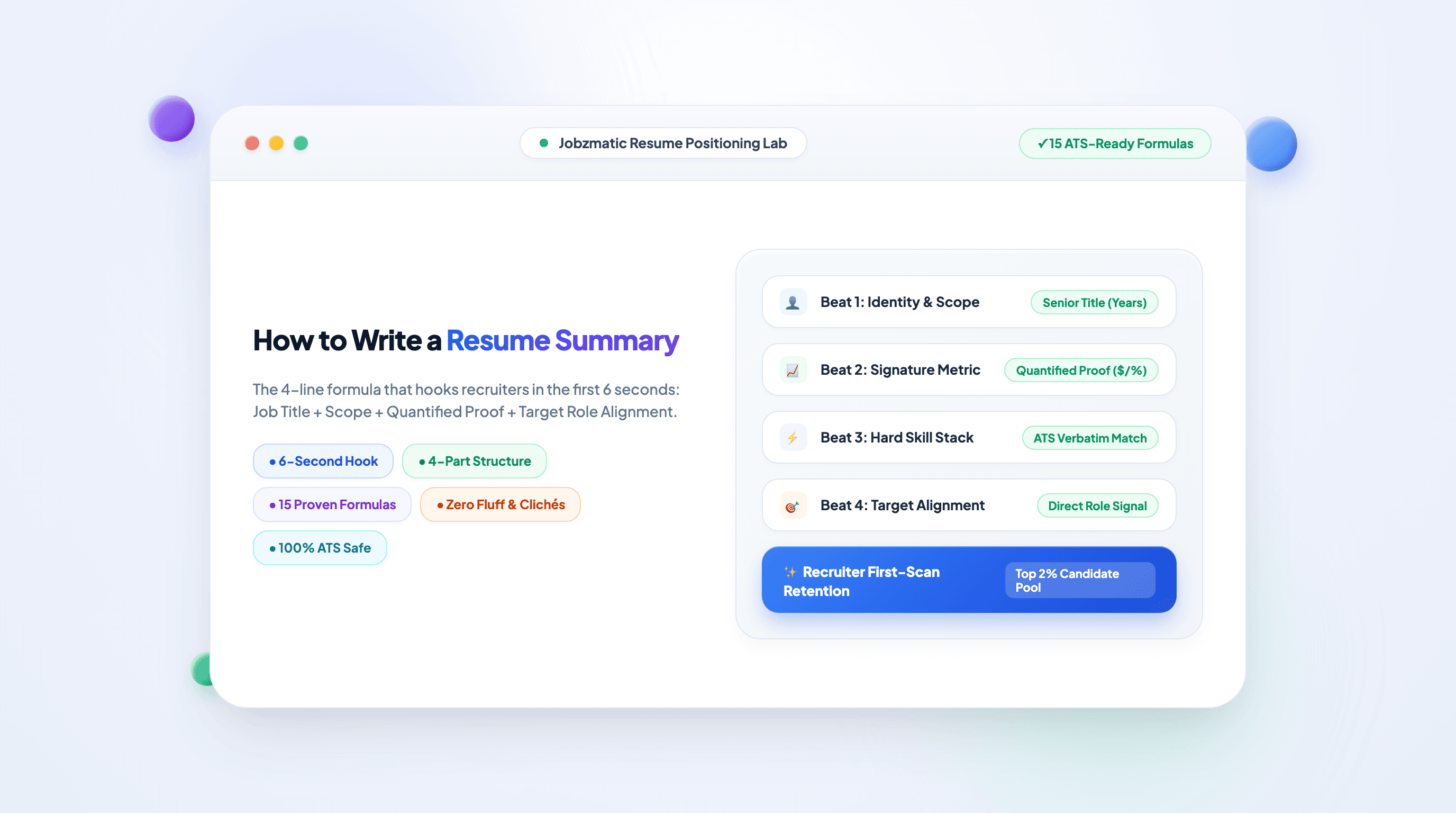
How to Write a Resume Summary: 15 ATS-Ready Examples for 2026
TL;DR — A resume summary (also called a professional summary or summary of qualifications) is a 2–4 line paragraph at the top of your resume that states who you are, your strongest proof, and what you're targeting. Recruiters spend an average of 6–7 seconds on the first scan, and the summary is where that scan starts. The winning formula: [Job title] + [Years/scope] + [Top quantified achievement] + [Target role alignment]. Below: the formula, the mistakes that kill summaries, and 15 ATS-safe examples you can adapt in minutes.
What Is a Resume Summary (and When Do You Need One)?
A summary sits directly under your name and contact info, before your work experience. It answers one recruiter question in one breath: "Why should I keep reading this resume?"
Recruiter's First Scan (6 Seconds)
│
├── 0–2s: Name, title, contact → "Is this the right level and field?"
├── 2–5s: Summary paragraph → "Does this person have what we need?"
└── 5–7s: First job entry → "Does the proof match the promise?"
        └── If yes: full read. If no: archive.
Use a summary when:
- You have 2+ years of experience and a specific value proposition.
- You're changing careers and need to reframe your narrative (see our career change strategy in the resume formats guide).
- Your job title doesn't reflect your target role ("Customer Success Lead" applying for "Account Manager").
Skip the summary (use a brief objective line or nothing) when:
- You're a student with no internship experience—a skills-forward header works better (see resume with no experience).
- You're sending a directly-mirrored resume where your title already matches the posting.
Summary vs. Objective: Objectives state what you want ("Seeking a challenging role in..."). Summaries state what you deliver. Recruiters discount objectives; modern ATS-era resumes use summaries almost exclusively.
The 4-Part Summary Formula
Every high-performing summary contains four components in this order:
$$\text{[Adjective + Job Title]} + \text{[Years or Scope]} + \text{[Quantified Proof]} + \text{[Target Role Signal]}$$
| Part | Job | Example Fragment |
|---|---|---|
| 1. Identity | Tell the parser and recruiter your role family | "Detail-oriented Financial Analyst" |
| 2. Scope | Establish scale: years, team size, budget, volume | "with 6+ years in FP&A across $40M budgets" |
| 3. Proof | One number that would impress in this job | "cut monthly close time from 9 days to 4" |
| 4. Signal | Mirror the target role's exact language | "seeking to drive forecasting accuracy as Senior FP&A Analyst" |
Why this passes ATS: The identity phrase and target signal carry the title keywords. The scope and proof lines naturally contain the hard skills and tools from the posting. No stuffing required—the structure forces relevance.
The 5 Rules of a Summary That Reads Well and Parses Clean
- 2–4 lines, 40–70 words. Anything longer gets skimmed past.
- First person, implied. Write "Senior Product Manager with..." not "I am a Senior Product Manager...". Pronouns waste characters.
- At least one number. Years of experience, team size, revenue influenced, percentage improved—any metric beats none.
- Zero first-person fluff. Ban "hardworking", "go-getter", "team player" unless the posting uses that exact language.
- Tailor per application. Swap the proof metric and target signal to mirror each job's must-have keywords. (The Jobzmatic ATS Checker shows you which keywords your summary is missing in one scan.)
15 Resume Summary Examples You Can Adapt
General / Professional Roles
1. Operations Manager
Operations Manager with 8+ years scaling logistics for e-commerce brands. Cut fulfillment errors 34% and shipping costs $480k annually across 3 warehouses. Expert in Lean process design, WMS platforms, and vendor negotiation—now targeting senior ops leadership roles.
2. Executive Assistant
Executive Assistant with 10 years supporting C-suite leaders at fast-scaling tech companies. Managed calendars across 4 time zones, orchestrated 30+ board meetings, and built expense workflows that cut reconciliation time 60%. Known for absolute discretion and inbox-zero reliability.
3. Project Manager
PMP-certified Project Manager with 7 years delivering $2M–$15M IT programs on schedule. Led 12-person cross-functional teams, maintained 96% on-time milestone delivery, and reduced change-order costs 25% through rigorous scope management.
Career Changers
4. Teacher → Corporate Trainer
Corporate Trainer transitioning from 9 years of high-school instruction. Designed and delivered 200+ lessons to groups of 30+, achieving a 92% comprehension pass rate. Certified in instructional design (ATD), specializing in onboarding programs and LMS content (Workday Learning, Canvas).
5. Retail Manager → Customer Success
Customer Success specialist with 6 years of retail team leadership. Managed 400+ weekly customer escalations with a 94% resolution rate and grew loyalty-program signups 48% YoY. Strengths: retention playbooks, CRM hygiene (Salesforce), and de-escalation at scale.
6. Military → Logistics Coordinator
Logistics Coordinator with 8 years of supply-chain operations in the U.S. Army. Directed movement of $12M+ in equipment across 5 sites with zero audit findings. Secret-cleared, Six Sigma Green Belt, fluent in SAP and manual contingency planning under deadline pressure.
Students & Early Career
7. Recent Business Graduate
Business Analytics graduate (BBA, GPA 3.8) with two Fortune 500 internships. Built Tableau dashboards tracking $8M in ad spend and automated a weekly KPI report that saved analysts 6 hours weekly. Seeking a junior analyst role in marketing analytics.
8. Bootcamp Engineer
Full-stack developer (12-week immersive bootcamp + B.S. Biology) with 3 shipped React/Node projects including a real-time booking platform serving 1,200 users. Strong in TypeScript, PostgreSQL, and Git workflows; seeking a junior software engineer role on a product team.
Engineers & Technical
9. Software Engineer
Backend Software Engineer with 5 years building payment infrastructure in Python and Go. Reduced p95 API latency 41% by redesigning PostgreSQL indexing and Redis caching for 40M daily requests. Deep in AWS (EKS, Lambda, Terraform) and event-driven microservices.
10. Data Analyst
Data Analyst with 6 years turning messy operational data into decisions. Built 25+ SQL/Tableau dashboards adopted by 300+ weekly users; automated ETL pipelines in dbt that cut reporting lag from 5 days to 4 hours. Strong storyteller with executives and engineers alike.
11. DevOps Engineer
DevOps Engineer with 7 years running Kubernetes at scale. Cut deploy time from 45 minutes to 6 via GitHub Actions and ArgoCD; maintained 99.98% uptime across 3 regions. Terraform-managed infrastructure for 200+ microservices on AWS with automated cost guardrails.
Healthcare
12. Registered Nurse
Compassionate RN with 6 years of med-surg and ICU experience in a 400-bed teaching hospital. Precepted 14 new nurses, maintained 99% charting compliance (Epic), and holds BLS, ACLS, and CCRN certifications. Seeking a step-down unit role with a charge-nurse track.
13. Medical Assistant
Certified Medical Assistant with 4 years in multi-provider clinics. Handled 60+ patient intakes daily, maintained 100% HIPAA-compliant records in Epic, and reduced no-show rates 18% through a proactive reminder workflow. Bilingual (English/Spanish).
Sales, Marketing & Finance
14. Account Executive
B2B Account Executive with 7 years in SaaS, consistently at 110%+ of a $1.2M quota. Built a $4M pipeline from cold outbound (800+ touches/quarter) and closed 38 enterprise deals with an average ACV of $92k. Power user of Salesforce, Outreach, and MEDDIC qualification.
15. Marketing Manager
Digital Marketing Manager with 8 years owning $2.5M in annual paid media. Grew organic traffic 220% in 18 months through technical SEO and content clustering; cut CAC 31% via GA4-driven funnel experiments. Teams love my reporting clarity; executives love my forecasts.
Summary Mistakes That Trigger ATS and Recruiter Rejections
- The pronoun opener. "I am a highly motivated professional..." — wastes the highest-value real estate on filler words.
- The adjective salad. "Results-driven, passionate, detail-oriented self-starter..." — recruiters read these as noise; parsers gain zero match signal.
- The everything-bagel. Listing 6 different specializations signals mastery of none. Pick the 2–3 that match the posting.
- The copy-paste. The same generic summary on 100 applications never carries the target role's exact keywords. This is why tailored-but-short beats long-and-generic every time.
- The placeholder giveaway. "Seeking a challenging position at a forward-thinking company" — this is an objective, not a summary, and it matches no job description on earth.
Frequently Asked Questions (FAQ)
What is the difference between a resume summary and a profile?
They're the same thing. "Professional profile", "career summary", "summary of qualifications", and "resume summary" all refer to the top-of-resume positioning paragraph. Use the standard heading "Professional Summary"—parsers recognize it reliably.
Should a resume summary be a paragraph or bullets?
Both work. A paragraph (2–4 lines) is the default and reads fastest. A 3-bullet "Summary of Qualifications" format works well for career changers who need to group proof by theme. Never mix: one or the other, never six bullets.
How long should a professional summary be?
40–70 words, 2–4 lines. Executives with deep track records can stretch to 5 lines, but every line must carry a number or a must-have keyword.
Do I need a summary if I have no work experience?
Usually not—students do better with a skills-forward header plus a strong projects and internships section. See our complete guide: How to Make a Resume With No Experience.
Rewrite Every Summary in Seconds, Not Hours
Jobzmatic generates a tailored, keyword-calibrated summary for every application—then fills it into every form automatically: