Tell Me About Yourself: The Present–Past–Future Formula (5 Examples for 2026)
Tell Me About Yourself: The Present–Past–Future Formula (5 Examples for 2026)
TL;DR — "Tell me about yourself" is not small talk and not a biography request. It's a structured prompt: position yourself for this role in 90 seconds. The winning structure is Present → Past → Future: what you do now (with scale), the 2–3 proof points that led there (with metrics), and why that points at this job. Prepare it, practice it out loud, and you'll convert the most predictable question in interviewing into a controlled opening statement.
Why This Question Decides the Interview's Tone
It opens nearly every interview, which means it does three things at once:
What "Tell Me About Yourself" Actually Evaluates
│
├── 1. Communication — Can you structure thoughts under pressure?
├── 2. Relevance — Do you know which parts of your story matter HERE?
└── 3. Confidence — Are you comfortable summarizing your value?
         └── Sets the interviewer's expectations for every answer after it.
The interviewer has your resume. They're not asking for information—they're asking for a thesis. The candidates who fail give three wrong genres of answer:
- The full biography — "I was born in Ohio, went to Ohio State..." (5 minutes in, no point made, interviewer checking the clock)
- The resume recital — reading bullets they've already read, adding zero new signal
- The humble ramble — "Well, it's a long story, I kind of fell into my field..." (instantly repositions you as unprepared)
The Present–Past–Future Formula
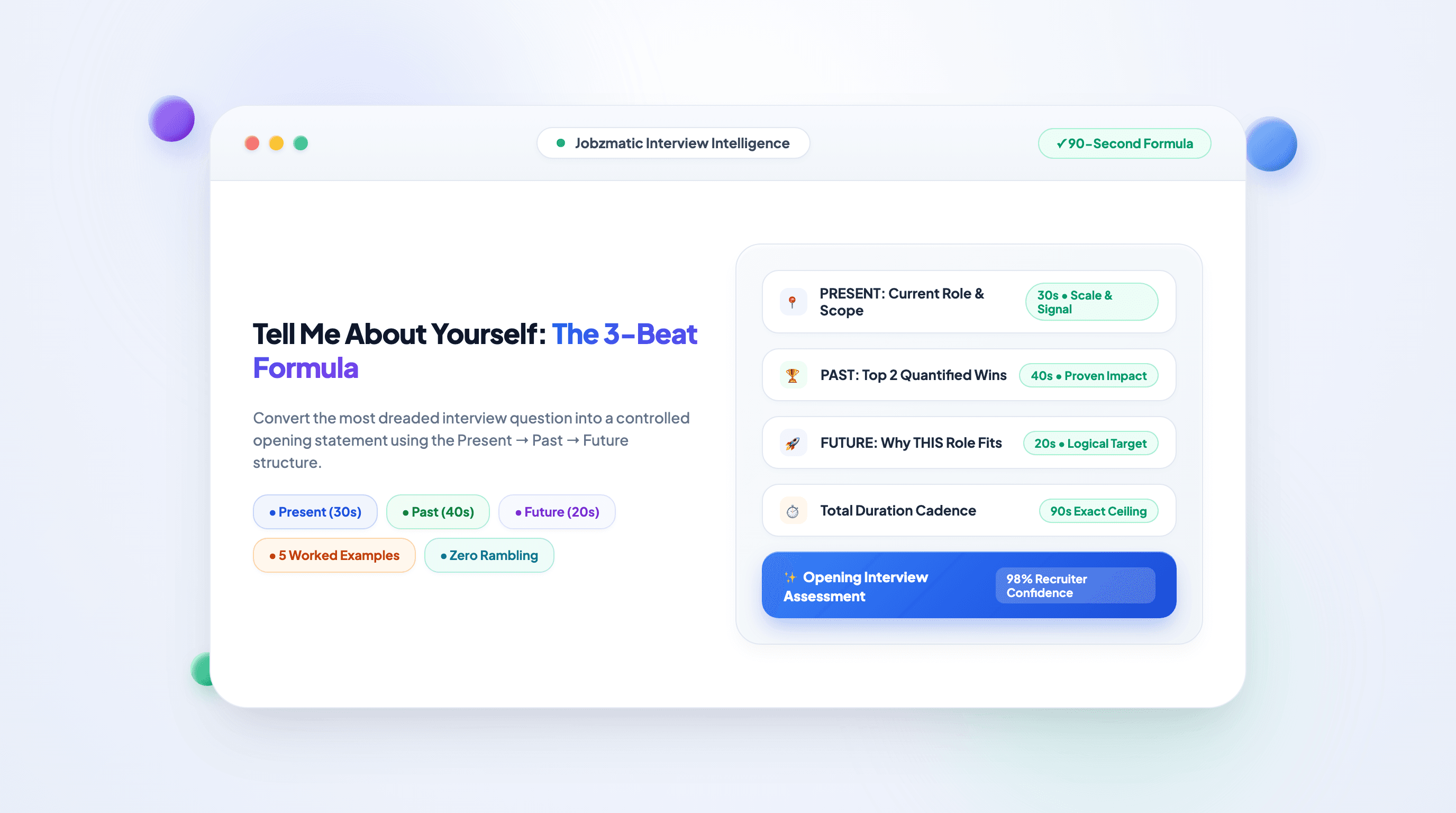
Three beats, 90 seconds, ~200 spoken words:
| Beat | Content | Time | Job |
|---|---|---|---|
| PRESENT | Current role + scope + one signature metric | ~30s | Anchor your identity in the role family they're hiring |
| PAST | The 2–3 prior proof points that explain your present | ~40s | Show the trajectory and the skills the posting demands |
| FUTURE | Why this role is the logical next step | ~20s | Land the answer where they're standing |
Building your version, beat by beat
Beat 1 — Present (30s):
- Job title + company type + scale ("...at a Series B fintech, where I own...")
- One number that establishes magnitude: team size, budget, volume, growth rate
- End with the responsibility most relevant to the job you're interviewing for
Beat 2 — Past (40s):
- The two or three roles/experiences that built the skills in the job description
- One metric per stop, max — trajectory over completeness
- Deliberately skip anything irrelevant ("irrelevant" includes tangents you're proud of)
Beat 3 — Future (20s):
- Name the target role's core problem and connect your arc to it
- Close forward: "...which is exactly why I'm excited about this role"
- Do not end with "so, yeah" — land on the excitement sentence.
The three delivery rules
- Practice out loud, 5+ times — to a mirror, a voice memo, or an AI mock-interview. In-your-head rehearsal fails at the moment of pressure. (Full practice loop in the interview questions guide.)
- Memorize the map, not the script — three beats with keywords; the wording should breathe.
- Match the formality of the room — same structure, adjusted tone for the startup founder vs. the Fortune 500 panel.
5 Copy-Adaptable Examples
1. Experienced Professional (Steady Trajectory)
"I'm a senior data analyst at a national insurance group, where I own the claims-fraud dashboard that 200+ adjusters use daily — we've cut false-positive reviews 35% this year. Before that I spent three years at a retail analytics firm building demand-forecasting models in SQL and Python, and I started my career in operations, which is where I learned to translate messy business questions into data problems. Fraud analytics at this scale is exactly the kind of challenge I've been building toward, which is why this role jumped out at me."
2. Career Changer
"I'm currently a customer success manager at a B2B SaaS company, managing $2M in accounts with a 96% retention rate. My path here ran through education — I taught high school math for six years, where I learned to take complex material and make it land for completely different audiences, and I moved into CS two years ago because that skill turned out to be my superpower with customers. I'm excited about this role because your team owns enterprise onboarding, and turning complicated rollouts into confident customers is precisely the work I love most."
3. Recent Graduate
"I just finished my computer science degree at UW, where I specialized in systems and led the development team for our capstone — a bike-share routing app that won the department showcase and now has 800 monthly users. Alongside that I did two internships: one at a logistics startup where I built the internal shipment-tracking tool, and one at a mid-size consultancy where I learned client communication the fast way. I'm looking to join a product team where I can ship real features from week one, and your startup's engineering blog is honestly why I applied here first."
4. Contractor / Freelancer
"I run a one-person design studio where I've spent the last four years helping Series A startups build their first brand systems — 30+ clients, most referred. Before going independent I was a designer at two agencies, which is where I learned to work fast without breaking consistency. I'm talking with you because I miss building one product deeply instead of breadth across many, and joining your team for the design-lead role is the version of that I want."
5. Returning After a Gap
"I'm a project manager returning to full-time work after a planned two-year break for family caregiving — a decision I made deliberately and would make again. Before the break I ran IT infrastructure projects at a healthcare company, delivering a $3M data-center migration on schedule, and I kept sharp during the gap with a PMP certification and volunteer project work for a local nonprofit. I'm ready to re-engage fully, and this role is attractive because healthcare IT is exactly where my depth is."
Notice what all five share: every beat is doing a job — no random facts, each example ends pointed at the target role, and each contains at least one number. That's the formula at work.
4 Variations of the Question (Same Answer, Re-Tuned)
| Variant | What They Want | Re-Tune |
|---|---|---|
| "Walk me through your resume." | Chronology, transitions, reasons for moves | Shift weight to the PAST beat; explain each transition in one line |
| "How would your colleagues describe you?" | Self-awareness + collaboration | Keep the structure; swap metrics for two traits with proof |
| "What should I know that's not on your resume?" | Personality, originality | One interest that connects to a work skill + one genuine quirk |
| "Why are you the best fit for this role?" | Confidence + fit | Keep PRESENT and FUTURE beats; compress PAST to one sentence |
Prepare the formula once, re-tune per variant — 80% of the work is done.
Frequently Asked Questions (FAQ)
How long should a "tell me about yourself" answer be?
90 seconds, roughly 200 spoken words. Under 45 seconds reads as unrehearsed or evasive; over 2.5 minutes turns the interview's opening into your monologue. The interviewer should be leaning in when you finish.
Should I mention personal details or hobbies?
Only if they're relevant or strategically humanizing. "I coach my daughter's soccer team" can land well late in the answer for leadership roles; your full travel history cannot. Default to professional content with, at most, one warm personal note.
Is it different for video interviews?
Structurally identical; delivery changes. Look at the camera for your opening beat, keep energy slightly higher than in-person (video flattens affect), and have your three-beat map on a sticky note beside the lens — never read from a screen.
What if I'm nervous and go blank?
Fall back to the map: Present → Past → Future. Say the beat names in your head and fill the slot. Interviewers don't know your script; a slightly slower, structured answer always beats a panicked one. This is exactly what the out-loud practice reps are for.
Get the Interview First — Automate the Applications
A great "tell me about yourself" only matters if the interview happens. Jobzmatic gets your resume past the ATS and the applications in: