How to Answer the How Did You Hear About Us Question on Job Applications (2026)
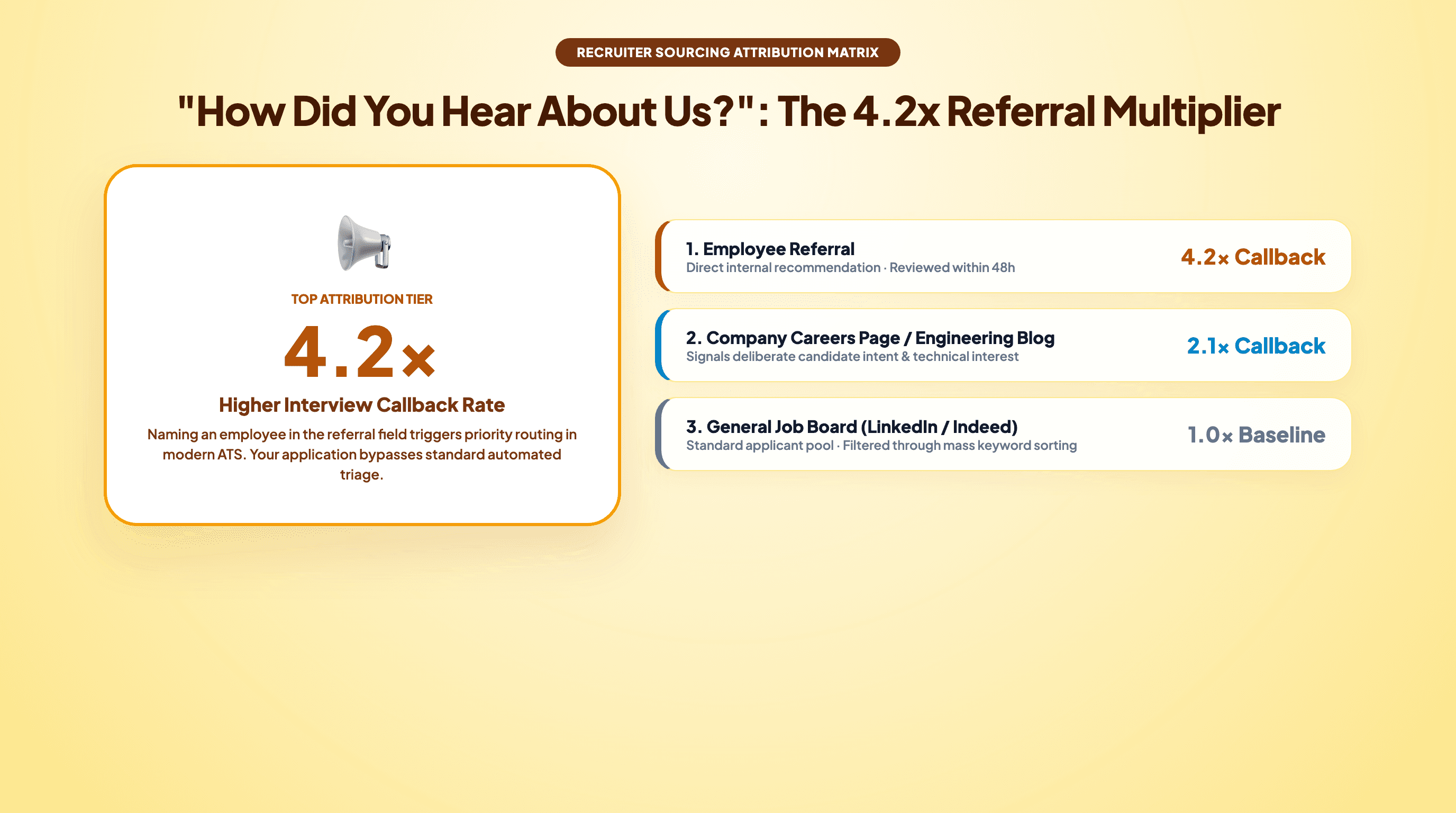
How to Answer the How Did You Hear About Us Question on Job Applications (2026)
TL;DR — This field is recruiting-channel attribution, not a candidate filter. Name a person only if they actually referred you and agreed to it; otherwise pick the real channel from the dropdown, such as LinkedIn, Indeed, or the company careers page. If a tool applied for you, answer with the channel where the job was discovered, never a fabricated employee. Recruiters verify named referrals, and a false claim can cost that employee a referral bonus while corrupting the employer's sourcing data.
What the Field Is Really For
The "How did you hear about us?" dropdown looks like small talk. It is data collection, and it feeds two systems inside the employer's recruiting stack:
- Recruiting-channel attribution. Sourcing teams split budget across job boards, careers-site traffic, agencies, and employee networks. Your answer lands in a sourcing dashboard that decides where that budget goes next quarter.
- Referral-bonus accounting. Name an employee and the ATS attaches that name to your candidate record. If you are hired, the referral program pays out based on that field.
Here is what almost everyone misses: the field is not used to evaluate you. No recruiter ranks candidates by how they found the posting. It is plumbing between your application and the company's analytics, so there is no clever answer and no advantage to manufacture. Accuracy is the only strategy that helps anyone, including you:
Referral source (your dropdown answer)
        │
        ▼
Recruiter sourcing dashboard
        │   attribution: which channels actually produce hires?
        ▼
Attribution outcome
        ├── "Referred by Jane Doe" → fast-track review + Jane's referral bonus
        ├── "LinkedIn"             → LinkedIn sourcing spend gets the credit
        └── "Other"                → unattributed; channel data quietly degrades
A wrong answer rarely hurts your candidacy. It misroutes credit, and the people it affects are the referrer who earned a bonus and the recruiting team measuring which channels work.
The Honest Answer Rules
Three cases cover nearly every application:
1. A person referred you, and they agreed to it. Name them, spelled exactly as they gave it, using the referral option in the dropdown. This is the one case where the field adds real interview probability, because many companies fast-track named referrals through a dedicated review queue before general applicants are read.
2. You found the posting on a job board. Pick the actual board from the dropdown: LinkedIn, Indeed, the company careers page, whatever the real source was. Do not overthink it; the dropdown exists for exactly this answer.
3. A tool applied for you. If a service discovered the posting and submitted the application for you, answer with the channel where the job was actually discovered: the board it surfaced on or the careers page it came from. Never fabricate a person. Automation changed how you applied, not where the job came from, and the original discovery channel is the truthful answer.
If you used Easy Apply on LinkedIn, the honest answer is LinkedIn. If you weighed that workflow against applying directly on the employer's ATS, the trade-offs are covered in our LinkedIn Easy Apply versus direct ATS apply comparison.
The Fake-Referral Mistake
Naming an employee who did not refer you is the most common way this field goes wrong, because referrals sound like an edge. The result is the opposite:
- The verification moment. Recruiters do check. A named referral prompts a message to that employee asking whether they know you. When the answer is no, your record carries a false statement in writing, permanently attached to your name in the ATS.
- The bonus problem. If you are hired, the referral program may pay the named employee. When payout review reveals the referral was fabricated, it can cost that employee a legitimate bonus and exposes them to program-abuse review.
- The data problem. Fake referrals inflate the referral channel's hire rate and misdirect sourcing budgets.
Some ATS platforms also let the named referrer see your application status, so a stranger gains visibility into your candidacy. If you want the referral edge, ask someone who actually knows your work, get their agreement first, and only then name them.
Free-Text Answers: Short and Factual
Some versions of the field are a free-text box instead of a dropdown. The best answer is short, factual, and complete in one sentence:
Found the posting via LinkedIn, applied through the company careers page.
That line gives the analytics both facts it needs: the discovery channel and the application channel. Avoid essays, because nobody reading a sourcing report wants your job-search story. Avoid jokes, which read as flippant in a parsed field. Avoid vague filler like "the internet", which gives the dashboard nothing. If the field is optional, a factual one-liner still beats leaving it blank.
If an Agency or Headhunter Submitted You
If a recruiter at a staffing agency presented the role and submitted your application on your behalf, name the agency, not a person inside the hiring company and not a job board.
The critical rule: do not double-apply directly. If the agency already entered you into the employer's ATS and you apply again through the careers page, you create duplicate candidate records. Duplicates confuse recruiters, can breach the agency's representation agreement, and make attribution impossible. If you are unsure whether the agency submitted you, ask before applying anywhere yourself. One record, one source of truth: the agency's name.
How Jobzmatic Answers It
When the Jobzmatic browser extension for Chrome and Firefox meets a referral-source field, it resolves the answer through a five-layer decision engine instead of guessing:
- Layer 0: resume-data heuristics. Direct matches against your structured profile.
- Layer 1: past approved answers. Answers you approved on previous applications, stored locally and reused.
- Layer 2: Knowledge Bank lookup. Custom Q&A items you defined in your Jobzmatic profile.
- Layer 3: statistical rules. Offline inference from category heuristics.
- Layer 4: AI fallback. Only when Layers 0-3 produce no confident answer.
Referral-source fields usually resolve at Layer 1 or Layer 3, because the honest answer is the channel where the job was discovered, and the extension knows exactly which board or careers page surfaced the posting. The extension runs client-side inside your own logged-in browser session, never asks for your LinkedIn or ATS passwords, and supports 40+ ATS platforms including Workday, Greenhouse, Lever, and Ashby.
Every application is held for your review before submission, with a confirmation screenshot afterwards. Attribution stays truthful by design: the extension fills the real channel, and you confirm the answer before anything is submitted. Daily caps are 5 applications per day on the free tier, 15 on Pro ($9/mo), and 50 on ProMax; the free tier includes 1,000 credits with no credit card required. To go deeper, start with how to automate job applications with AI, then the AI auto-apply conversion guide for turning submitted applications into interviews, or head straight to auto-apply.
Frequently Asked Questions
Does the referral-source answer affect my chances?
Almost never. Recruiters use it for channel attribution and referral accounting, not candidate ranking. The one exception is a named referral with the employee's agreement, which many companies route into a faster review queue. Every other dropdown option is roughly equal.
Can I say I was referred by someone who did not refer me?
No. Recruiters verify named referrals, and the claim becomes a written false statement inside your candidate record. If you are hired, payout review can catch the fabrication and cost the named employee a referral bonus. If you want the referral path, ask someone who knows your work and get their agreement first.
What if I genuinely do not remember where I saw the job?
Check your browser history first; it usually settles the question in thirty seconds. If it does not, pick the most likely real channel from the dropdown or write an honest one-liner such as "Found the posting via LinkedIn." The field feeds analytics, so a best-effort accurate guess beats a fabricated referral every time.
Is "other" a bad answer?
It will not count against you, but it is the least useful answer for everyone. "Other" adds an unattributed data point to the sourcing dashboard and tells the recruiting team nothing. Use it only when no option matches and you cannot identify the real channel; otherwise pick the closest truthful option.
What should I put if an auto-apply tool submitted the application?
The channel where the job was discovered: the board it appeared on or the company careers page it came from. The tool changed how you applied, not where the job came from. Jobzmatic resolves this automatically from your session and holds the answer for your review before submission, so the attribution stays truthful.