How to Answer US Work Authorization Questions on Job Applications (2026)
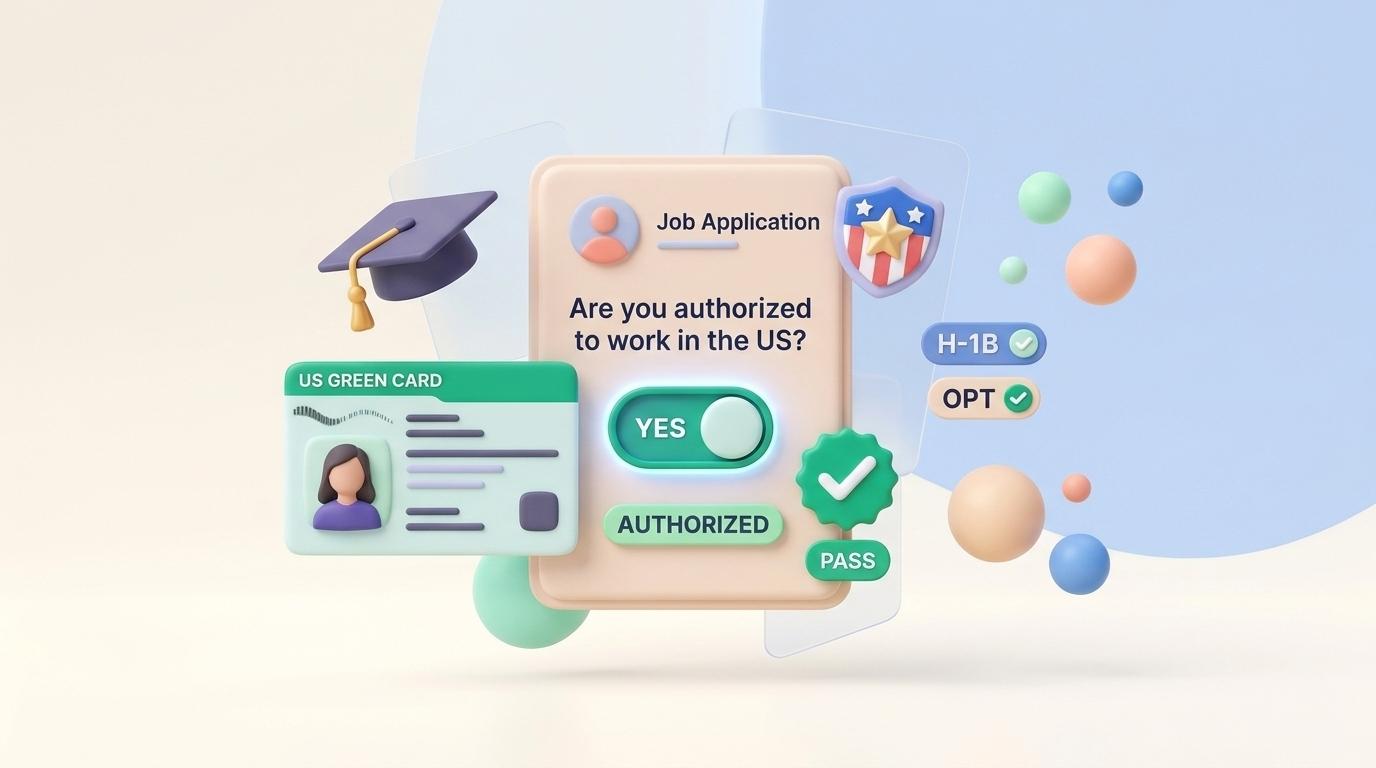
How to Answer US Work Authorization Questions on Job Applications (2026)
TL;DR — "Are you legally authorized to work in the United States?" asks about your right to work today; "Will you now or in the future require sponsorship?" asks whether the employer will ever need to petition for you. Answer Yes/Yes if you are on H-1B (transfer), OPT, CPT, or a dependent EAD, and Yes/No only if you are a US citizen or green card holder. Never answer "no sponsorship required" when a petition is in your future; the gap surfaces at background check and gets offers rescinded. Jobzmatic stores your verified status once and resolves these fields through a 5-layer engine, so the knockout question is answered the same way every time.
Why Employers Ask the Work Authorization Question
Every US employer must verify that every hire is legally allowed to work (I-9, and E-Verify for many employers), so an ATS field is the cheapest place to filter out candidates who could never be onboarded. Sponsorship is a separate, real commitment: government filing fees, legal work, and processing timelines measured in months, with no guaranteed outcome for cap-subject petitions. Recruiters use it to segment the pipeline before interviews.
One clarification: the question itself is lawful. Asking whether you can work in the US and whether the employer must sponsor you is standard screening; what anti-discrimination law regulates is the decision, not the question, so employers may not reject you over protected characteristics such as national origin. The field only hurts you when your answer is inaccurate.
The Question Variants Are Not Interchangeable
"Are you legally authorized to work in the United States?" is present tense. Citizens, green card holders, people currently employed on H-1B, and anyone on OPT, CPT, or a valid EAD all answer Yes; the honest "No" belongs only to someone with no current work authorization.
"Will you now or in the future require sponsorship?" and "Do you require sponsorship now or in the future?" fuse two questions: "now" is whether the employer must file something before day one; "future" is whether it must file at any point during your employment.
Answering them separately matters because the truthful answers diverge:
- An H-1B transfer candidate does not require new sponsorship but does require employer petition cooperation. A new employer files a transfer petition before you start, with no cap lottery for you. The honest pattern: "authorized now: yes; employer action required: yes," with a note: H-1B transfer, not a new cap petition.
- OPT and STEM OPT candidates require sponsorship only later. You are authorized today with a fixed end date, so the future half controls: the answer is Yes even though you need nothing today.
The mirror error: green card holders who answer "Yes" to future sponsorship filter themselves out of roles they qualify for.
These fields appear in LinkedIn's Easy Apply and direct ATS applications alike; the routes differ in review speed, not the questions (see LinkedIn Easy Apply vs Direct ATS Apply).
The Authorization Question Decision Tree
Map your status before you open the form:
The authorization question decision tree: status → current right to work → sponsorship need → truthful field mapping

Citizen / green card holder
 ├─ Right to work now: YES (no end date)
 └─ Sponsorship ever: NO
     └─ Fields: "Authorized: Yes" + "Sponsorship: No" (both halves)

H-1B (transfer candidate)
 ├─ Right to work now: YES (valid through your approved petition end date)
 └─ Sponsorship: YES, employer cooperation only
     └─ Fields: "Authorized: Yes" + "Sponsorship: Yes" + note "H-1B transfer,
        not a new cap petition"

OPT / STEM OPT / CPT
 ├─ Right to work now: YES (with a hard end date)
 └─ Sponsorship: YES, in the future
     └─ Fields: "Authorized: Yes" + "Sponsorship: Yes (future)" + note your runway

Dependent EAD (L-2, H-4 EAD)
 ├─ Right to work now: YES (renewals tied to the primary visa holder)
 └─ Sponsorship: depends on your long-term plan
     └─ Fields: "Authorized: Yes" + "Sponsorship: Yes (future)" unless your
        path to permanent residence needs no employer petition
Authorized-now and sponsorship-need are independent axes, and the "future" half covers your whole possible employment, not just month one.
Truthful Answer Patterns by Status
US citizen. Authorized: Yes. Sponsorship: No, on every variant, present and future.
Green card holder (lawful permanent resident). Authorized: Yes. Sponsorship: No, including the future. Permanent residents can work for any US employer indefinitely and never need a petition, so a form that asks about "ever" still gets No.
H-1B (transfer). Authorized: Yes, while your approved petition is valid. Sponsorship: Yes, with context. The new employer must carry a transfer petition, but that is not a new cap-subject sponsorship and involves no lottery for you. Say exactly that in a comment field; recruiters read "H-1B transfer" very differently from "new sponsorship."
OPT / CPT. Authorized: Yes, with an end date (12 months of OPT, extended by 24 for eligible STEM graduates; CPT runs through your degree program). Sponsorship: Yes, in the future on any "now or in the future" phrasing. Use the comment field for your runway: remaining months of authorization and whether you will pursue the STEM extension.
EAD / dependent statuses (L-2, H-4 EAD, and similar). Authorized: Yes, while your EAD is valid, with renewals tied to the primary visa holder's status. Sponsorship: per your plan. If you will need your own visa category eventually, answer Yes (future); if your path to permanent residence involves no employer petition, "No" is truthful, but only if that plan is certain.
For the employer-side view, see Auto-Apply to USA Jobs With Visa Sponsorship.
The Honesty Rule: Never Understate Sponsorship
The temptation is structural: the sponsorship field is a filter, and "No" passes the filter. Resist it, because the gap always surfaces, and later is worse. Your EAD or status has an end date; at onboarding, I-9 re-verification, or E-Verify re-check, the employer learns that continuing your employment requires a petition it was told it would never need. That discovery happens after offers are signed, exactly when rescissions occur.
A truthful "Yes" costs you nothing but pipeline segmentation; a false "No" costs you the offer and the months of interviewing. The honesty applies in reverse too: citizens and green card holders who answer "Yes" to sponsorship they will never need discard interviews they were eligible for. Answer for the whole horizon the question asks about, not just day one.
What Sponsorship Actually Weighs on the Employer Side
When an employer reads "Yes" on sponsorship, it prices three things: government filing fees, legal and advisory costs, and timeline. Petitions take months, and cap-subject H-1B hiring waits on an annual cycle with a selection step that guarantees nothing; that is why the question exists on the form.
The implication for you: precise answers let employers price the real commitment. "H-1B transfer, no cap petition" and "OPT now, petition needed in two years" are very different commitments; the note field is where that difference gets communicated.
How Jobzmatic Answers It Consistently on Every Application
One guessed dropdown here can end a process you were qualified for. The Jobzmatic browser extension for Chrome and Firefox prevents that: you enter your work-authorization status once, in your profile, and verify it. When an application presents an authorization or sponsorship field, the extension resolves it through the 5-layer engine:
- Layer 0: resume-data heuristics. Your stored status (citizen, green card, H-1B, OPT, EAD) maps directly to the field with zero latency and no AI cost.
- Layer 1: past approved answers. Approved answers from earlier applications are reused, so a correction made once becomes permanent.
- Layer 2: Knowledge Bank. Saved custom Q&A entries, such as "H-1B transfer, not a new cap petition," are matched to comment fields.
- Layer 3: statistical offline rules. Question phrasing variants ("now or in the future," "ever require") are mapped to the correct field semantics without a network call.
- Layer 4: AI fallback. Only when Layers 0 through 3 cannot resolve the phrasing does a prioritized queue engage, and the result is still held for your review.
Every application is held for review before submission and never auto-submitted, with a confirmation screenshot afterwards. It runs client-side inside your own logged-in browser session and never asks for your LinkedIn or ATS passwords. It handles 40+ ATS platforms, including Workday, Greenhouse, Lever, and Ashby, with daily caps of 5 free, 15 on Pro, 50 on ProMax. The free tier includes 1,000 credits, no credit card required; Pro is $9/mo.
Comparing options? The evaluation criteria are in Best AI Auto-Apply Tools for US Jobs; the product itself is at Jobzmatic Auto-Apply.
Frequently Asked Questions
Can employers ask about visa status on job applications?
Yes. Asking about work authorization and sponsorship is lawful screening; employers must verify work authorization for every hire anyway. What the law regulates is the decision, not the question: rejecting candidates over national origin, or applying citizenship preferences the law does not permit, is discrimination.
Is "require sponsorship now or in the future" a dealbreaker for OPT STEM holders?
It is a filter, not a verdict. Some employers screen out any future petition; many sponsor and read the rest of your application first. Answer truthfully (Yes, future), note your remaining OPT and STEM OPT months, and let sponsoring employers self-select in; a false "No" only moves the rejection to the background-check stage.
Do green card holders need sponsorship?
No. Lawful permanent residents can work for any US employer indefinitely, so the correct answers are "authorized: Yes" and "sponsorship: No" on both present and future halves. The common mistake is answering "Yes" to future sponsorship out of caution, which filters you out of roles you qualify for.
Should I answer yes to sponsorship if my OPT ends in two years?
Yes, whenever the question includes "in the future." OPT is temporary authorization with a fixed end date, and employment after it (and any STEM OPT extension) requires a petition. Answer "authorized: Yes," "sponsorship: Yes (future)," and note your runway in any comment field; employers who cannot plan for that will filter you out, which beats a rescinded offer.